Seeking Shelter in Lava Tubes | Reporting RIS4E: New Mexico
Rocky bodies like the Earth, moon, Mars and Venus have a similar fiery history that leaves fingerprints in their crusts. Volcanic activity on the Earth leaves behind dark, basaltic rock from lava that broke through the surface and cooled in various ways. Lava can come in contact with ground water and explode, leaving a ragged crater. It can flow far and fast over itself and create huge shield-like mounds. It can harden and collapse into deep pits and, sometimes, drain away to leave hollow tubes underground. These tubes on Earth can be big enough for people to stand in, and on the Moon, big enough for cities to stand in.
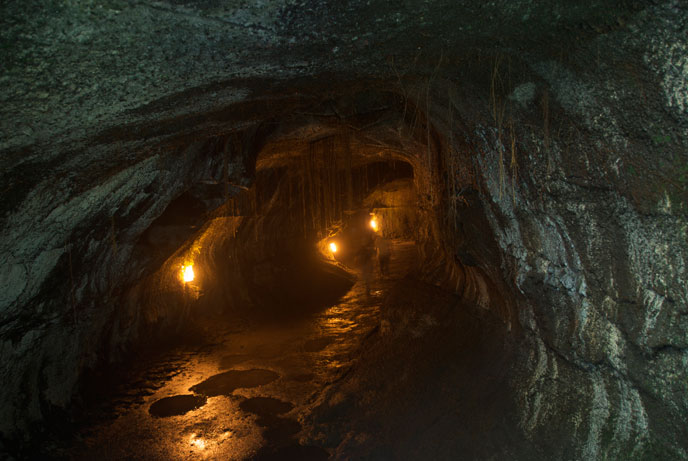
The Thurston Lava Tube is a main attraction for visitors of Hawaii Volcanoes National Park. (National Park Service)
RIS4E, a NASA-funded group of researchers at Stony Brook University and other institutions, studies key aspects of the geology of rocky bodies in the solar system, including these lava tubes and pits. By researching the dark, basaltic rock of volcanic fields on Earth, scientists can make guesses about the dark, basaltic rock on the moon and Mars, and the processes that were at play in their molten past. To geologists like Brent Garry, a RIS4E co-investigator, these volcanic processes are fascinating on their own. But to NASA, another reason for studying lava tunnels on Earth is the prospect of using lava tunnels on the moon as shelter to protect astronauts from radiation.
“The idea has been around for a while,” Garry said. “We just didn’t have the instruments that could get us the resolution to actually search the lunar surface for these things.”
RIS4E will be researching these lava tunnels at Potrillo volcanic field in New Mexico this June and studying, among other topics, the difference between lava tube and lava pit formation, which is key to finding them on the moon and Mars.
When lava hits the Earth’s surface at around 1,200 C (2,192 F), it cools very quickly, leaving a crust that new lava flows over, or under. Huge rivers of molten lava can continue to flow even within layers of crust that have hardened around them. These rivers create complicated networks of lava tunnels, most of which harden under the ground as the lava stops flowing. Other times, when the river has somewhere to drain, the lava leaves an empty tunnel that can be tens of feet tall and wide, like an underground lava hallway. On the moon, where these rivers, or lunar rilles, were much larger, tunnels can be miles wide.
A team from Purdue University in Indiana using computer modeling techniques and data from NASA’s Gravity Recovery and Interior Laboratory (GRAIL) reasoned that lava tubes on the moon could reach larger sizes than tubes on earth, due to less gravitational pressure. The lunar tubes could maintain stability up to three miles wide, according to the team’s paper, published in the journal Icarus in 2016.
On Earth, these tunnels are usually discovered in places where the ceiling has caved in, leaving skylight pits in the surface. But not all pits lead to tunnels. Sometimes, part of a lava flow will inflate and then collapse when it hardens, leaving a pit in the ground that goes straight down, but doesn’t connect to a tunnel.
Click here to see a short animation of lava tube formation. (Credit: Nicola Shannon)
Patrick Whelley, a geologist and RIS4E collaborator, works with Garry and uses a type of laser scanner called LiDAR (Light Detection and Ranging) and other equipment to make detailed maps of lava tunnels on Earth, in places like Hawaii and New Mexico. If instruments like LiDAR, as well as magnetic survey equipment and ground penetrating radar, can detect underground lava tubes from the surface of the Earth, they can be modified and used by astronauts or rovers to point in the right direction on Mars and the moon. The current lunar rovers use camera data to create topographic maps. Tools like LiDAR would be much faster and more precise.
“It’s just a matter of getting the instruments hooked up with the right team and actually getting a ride on a rover,” Whelley said.
On airless bodies like the moon and Mars, there is no magnetic field or thick atmosphere to protect from solar radiation or meteorites, which are problems for astronauts if NASA plans to send up longer term manned missions. If lava tunnels on the moon or Mars can be pinpointed by satellite, they could be used as shelter for astronauts. There are satellite images of multiple deep pits in the moon’s surface, but it is not known whether many of these pits are connected to lava tunnels or are simply inflation pits.
One lunar pit, in the Marius Hills, an area in the western hemisphere of the moon, was labeled a possible skylight after images were taken by Japan Aerospace Exploration Agency’s (JAXA) SELENE lunar orbiter in 2009. NASA’s GRAIL spacecraft found dips in their measurements of the moon’s gravity around that pit in March 2016, which also suggested void space under the ground around it. JAXA’s SELENE orbiter had similar findings this past March when their Lunar Radar Sounder picked up a double echo in a 25-mile line west of the pit, meaning the radar was bouncing off the surface and a second surface underneath the ground, perhaps the floor of a lava tube.
“That’s now the best evidence we have for an underground volcanic cave system on lava tube on the moon, or even Mars,” Garry said.
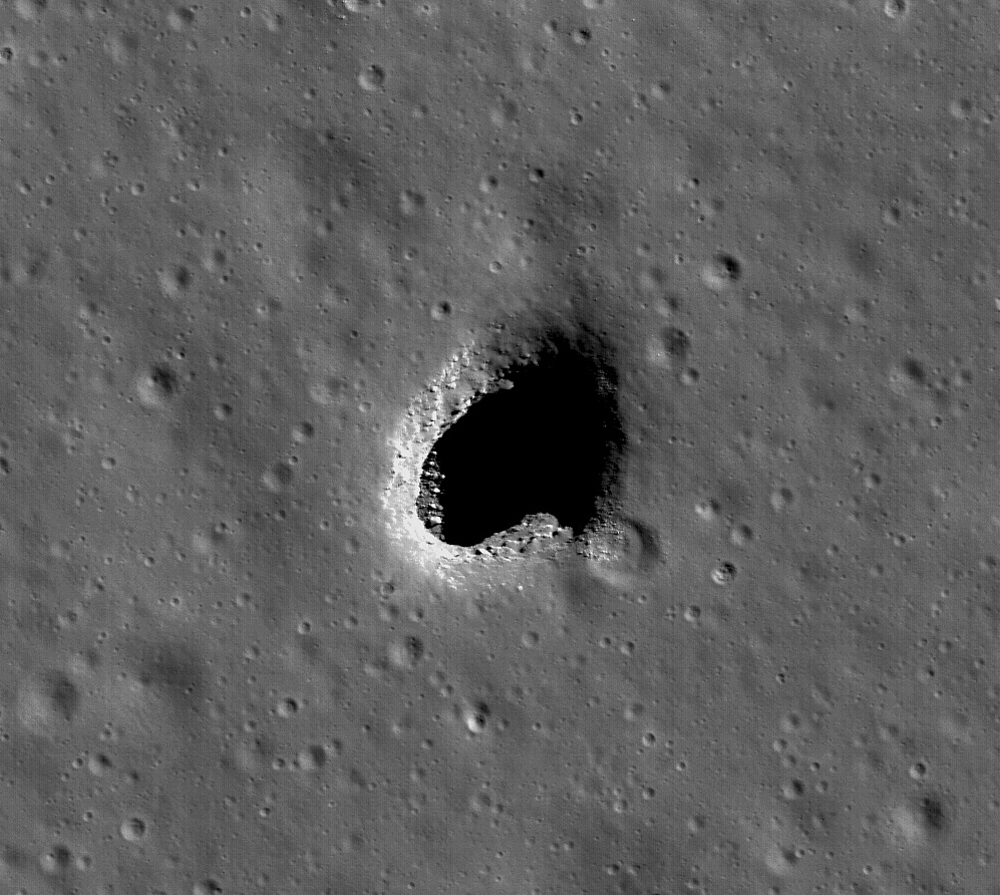
An image of a possible skylight pit in the Marius Hills, taken by the Lunar Reconnaissance Orbiter Camera. (NASA/Goddard Space Flight Center/Arizona State University)
Unfortunately, even if there is a giant hollow lava tunnel accessible by astronauts on the moon, this would not be an absolute safe haven from space radiation. Peter Guida, a biologist at NASA Space Radiation Laboratory (NSRL) at Brookhaven National Laboratory, researches space radiation and its effects on the human body, analyzing the risks astronauts will have to take on long missions in space.
“The first thing that needs to be defined when it comes to space radiation is it’s a very different type of radiation than most people are familiar with,” Guida said.

Click to expand comparisons of radiation measurements made with the MSL Radiation Assessment Detector on NASA’s Curiosity Mars rover. (NASA/Goddard Space Flight Center/Arizona State University)
Radiation on Earth generally refers to X-rays or gamma rays, which are types of protons, or hydrogen ions, and have no mass or charge. Space radiation on the other hand, has mass and charge. Much heavier elements, from hydrogen all the way to iron, are present in charged form in space, so they produce much heavier and more harmful radiation. This space radiation is capable of breaking a cell’s DNA in multiple different ways and places, leading to mutations and possible cancer, and also can simply kill cells altogether. Dense aluminum used for spacecraft blocks only about a quarter of the radiation that hits it, and polyethylene based plastics that are being developed block only one third. A protective lava tunnel would definitely add to the shield against this radiation. But especially in the event of a solar flare, Guida said, “it’s not a miracle cure.”