Kīlauea
The Big Island's Hard Rock Café
There are 13 microclimates and a continent's range of terrain on the island of Hawaii. Of all of them, it's the lava fields of Kīlauea that draw planetary scientists from around the world — terrain that approximates the Moon and Mars closely enough to rehearse on. In 2015, the RIS4E field team flew in from Johnson, Goddard, and Stony Brook for a ten-day trial of new geology instruments. A small group of student journalists came with them.
Searching For Life on the Red Planet
Amy McAdam, a planetary geochemist at NASA’s Goddard Space Flight Center and the X-ray diffraction instrument team lead for RIS4E’s Theme 2, spent the June 2015 field test on Kīlauea’s lava flows testing whether volcanic basalt altered by acidic rain could serve as an analog for Martian rock chemistry. Her work aimed to guide future astronauts toward the samples most likely to preserve signs of past life.
Volcano Love
Brent Garry, a volcanologist at NASA’s Goddard Space Flight Center, led the lidar team during the RIS4E field test at Kīlauea in June 2015, using laser pulses to capture the topography of Hawaii’s lava flows for comparison with volcanic landscapes on the Moon and Mars. A career built on lava flows across six countries gave him the reference library to read what the landscape was telling him.
America in Space: The Long Trip Back to the Moon—and Beyond
Forty-three years had passed since an American astronaut last set foot on another world when NASA launched SSERVI in 2013, funding nine research teams, including RIS4E, to rebuild the scientific foundation for human exploration beyond low-Earth orbit. Scientists and program managers argued that sustained, predictable funding, not another Apollo-scale surge, was the only path back to the Moon and on to Mars.
A Different Kind of Rock Collector
Cynthia Evans, a field geologist and astromaterials curator at NASA’s Johnson Space Center, brought her X-ray fluorescence expertise to the RIS4E field test at Kīlauea in June 2015. Working alongside Kelsey Young, she used XRF measurements to assess the chemical composition of surface rocks, helping to determine which samples future astronauts on the Moon or Mars should prioritize collecting.
Sage of the Expedition
Dean Eppler, a geologist at NASA’s Johnson Space Center with four decades of fieldwork behind him, served as crew team leader for the RIS4E field test at Kīlauea in June 2015. A veteran of spacesuit development and EVA planning, he guided the team through simulated extravehicular activities on the lava flows, drawing on a career’s worth of geological intuition to define how astronauts should conduct science on Mars.
A Geologist in the Violin Section
Debra Hurwitz, a planetary geologist on post-doctoral assignment at NASA’s Goddard Space Flight Center, joined the RIS4E crew team at Kīlauea in June 2015 on a self-funded basis, simulating the extravehicular activities astronauts would one day carry out on Mars. Alongside that crew work, she pursued separate research into how lava forms and its role in the planetary evolution of the solar system.
Never Stop Exploring
Gen Ito brought a rare combination to the RIS4E field test in June 2015: a graduate student in planetary science at Stony Brook University, he had already contributed to both the remote sensing and infrared spectroscopy sides of the project. A reconnaissance trip to Hawaii the previous fall sharpened the instruments he and his team would return with, and fueled an ambition that reached well beyond the lava fields.
Goddess of Fire
Kīlauea is the world’s most active volcano, and its Ka’u desert, still scarred by a dramatic 1974 eruption, drew the RIS4E team to Hawaii in June 2015. The basaltic lava fields that local rangers accept as a force of nature offered NASA scientists something rarer: a close Earth analog to the surfaces of the Moon, Mars, and near-Earth asteroids.
Astro Dome
While the RIS4E team worked Kīlauea’s lava fields in June 2015, another NASA-funded experiment was ending nearby atop Mauna Loa. Commander Martha Lenio and five crewmates had spent eight months inside a 36-foot dome on the volcano’s slope, living as if on the surface of Mars, to help researchers understand the human challenges of long-duration spaceflight.
An Odyssey Into Geology
Deanne Rogers, an assistant professor of geosciences at Stony Brook University and a co-investigator on the RIS4E project, led the thermal infrared imaging team at Kīlauea in June 2015. She designed five custom filters for a standard FLIR camera that expanded its spectral range, letting the team identify differences in rock mineralogy on the ground, the same method she applied to understanding how minerals on Mars formed.
The Right Hat for the Right Stuff
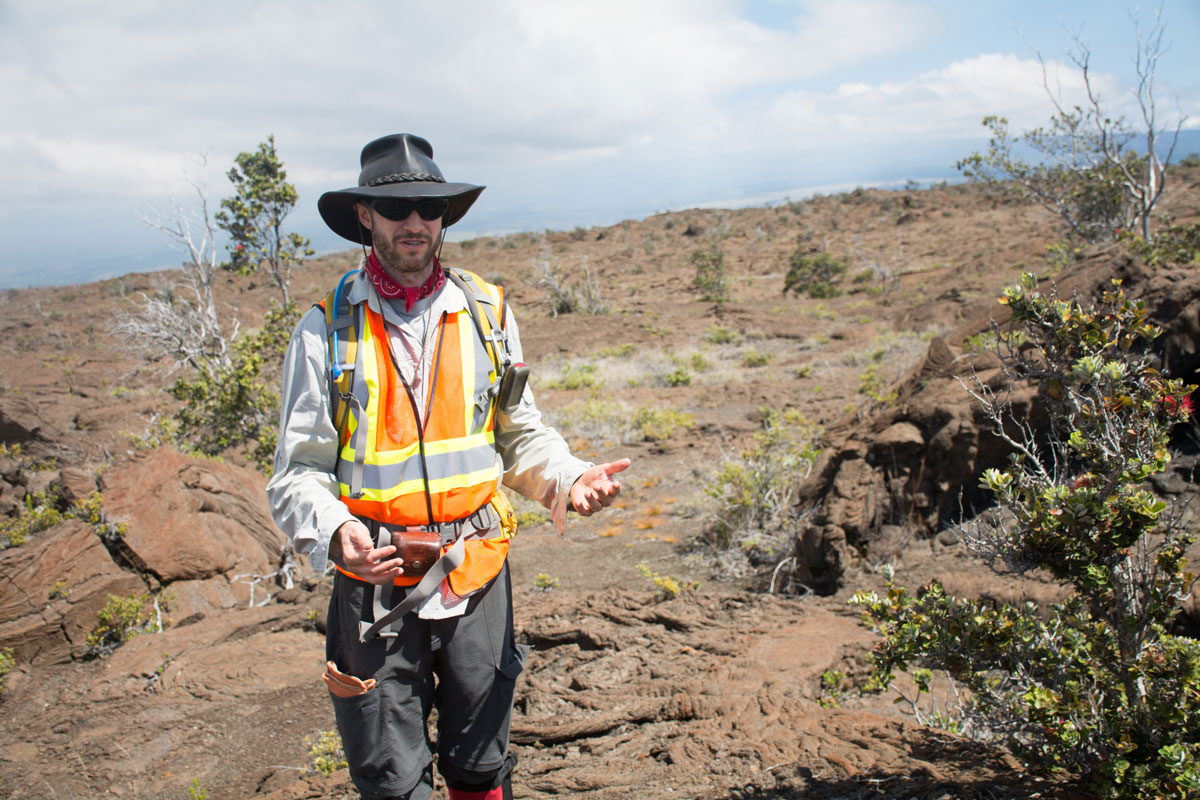
Jake Bleacher arrived at Kīlauea in June 2015 wearing both a signature black leather hat and an unfamiliar title: RIS4E field team leader. The volcanologist and planetary geologist at NASA Goddard had spent years training astronauts in field geology, but leading a mission meant trading his usual scientist’s focus for an overview of every instrument and every team.
Reading Mars’ Story
Jennifer Eigenbrode came to planetary geochemistry by way of geology and a lifelong conviction that rocks hold the record of life on Earth, and possibly elsewhere. At Kīlauea in June 2015, the NASA Goddard scientist joined the RIS4E field test to work with X-ray diffraction, refining a technique that could one day help astronauts identify minerals on the surface of Mars.
Science of His Own Design
Juergen Thieme spent six years overseeing construction of the X-ray Spectroscopy Beamline at Brookhaven National Laboratory’s National Synchrotron Light Source II, a nearly billion-dollar instrument he had designed himself. As a RIS4E Theme 4 collaborator, he planned to use that beamline to analyze rock samples returned from the June 2015 Kīlauea field test, a method scientists could one day apply to lunar or Martian samples.
The Indefatigable Geologist
Kelsey Young served as the RIS4E field team’s deputy leader and X-ray fluorescence team leader during the June 2015 Hawaii expedition. A post-doctoral geologist from NASA Goddard Space Flight Center, she and teammate Cynthia Evans tested a handheld XRF scanner across the lava fields of Kīlauea, chasing rock samples with the same tenacity she’d shown on expeditions across several continents.
LIDAR
NASA geologists Brent Garry and Patrick Whelley hauled a 50-pound laser instrument called LIDAR across the lava desert of Kīlauea in June 2015, scanning the terrain in three dimensions. The technology gave the RIS4E team a way to spatially revisit lava flows and outcrops from the lab, and tested whether a next-generation version could one day guide astronauts exploring another planet’s surface.
Scientist in the Making
Marcie Yant joined the RIS4E field study in Hawaii as a Ph.D. candidate in geosciences at Stony Brook University, invited by her advisor Deanne Rogers to assist with thermal infrared spectral imaging of the lava flow. Her path to the volcanic rock of Kīlauea wound through model rockets in Indiana, a double major in geology and biology, and a determination to combine research with teaching.
Guardian of the LIDAR
Patrick Whelley, a postdoctoral research fellow at NASA Goddard Space Flight Center, shouldered a 50-pound LIDAR instrument across the lava fields of Kīlauea during the June 2015 RIS4E expedition. A volcanologist who had studied craters from Chile to the world’s most remote peaks, Whelley brought the laser-ranging tool to Hawaii to distinguish lava flow types and test how such instruments could serve future planetary explorers.
A Down-to-Earth Space Traveler
Astronaut Rick Mastracchio spent ten days on the Big Island of Hawaii in June 2015 as a member of the RIS4E field study, simulating extra-vehicular activities across the lava flows of Kīlauea. A veteran of four missions and 53 hours of spacewalks, fifth-most in history, Mastracchio brought practical spaceflight expertise to help scientists refine the instruments and operational techniques needed for future planetary missions.
The Kite Geologist
While the rest of the RIS4E team carried spectrometers and laser instruments into the lava fields of Kīlauea in June 2015, postdoctoral planetary scientist Stephen Scheidt of the University of Arizona flew a kite. His custom camera rigs captured low-altitude aerial images that, stitched together through photogrammetry and layered onto LIDAR terrain models, gave geologists a bird’s-eye view of field sites they could revisit from the lab.
The Rise of RIS4E: Getting a Grasp on the Solar System
Tim Glotch grew up stargazing in Massachusetts before a childhood spark, NASA’s Pathfinder landing on Mars in 1997, redirected him from galaxies to geology. By 2013 he had assembled a $5.5 million NASA research team at Stony Brook University called RIS4E, pulling together trusted colleagues from Arizona State, NASA Goddard, and Brookhaven to study the rocks of the solar system from the ground up.
TIR Remote Sensing
Deanne Rogers, a geoscientist at Stony Brook, brought a modified infrared camera to Kīlauea’s lava fields in June 2015 to map rock mineralogy by heat signature rather than by eye. Her team fitted an off-the-shelf FLIR camera with custom spectral filters to produce multispectral images that could one day guide astronauts or rovers toward the most scientifically valuable samples on the Moon.
Clash Over a Telescope
When the RIS4E team arrived in Hawaii in 2015, a protest was already well underway on Mauna Kea, where native Hawaiians had successfully halted construction of the Thirty Meter Telescope since October 2014. The standoff captured a tension older than the space age: the summit that astronomers called the Northern Hemisphere’s finest observatory was, for many Hawaiians, a sacred ancestor that no telescope could justify disturbing.
The Big Island
The RIS4E field team flew to Hawaii Volcanoes National Park in early June 2015 not for the beaches but for the basalt. The Big Island’s hardened lava flows, some tens of thousands of years old and others barely cooled, offered the closest thing on Earth to the volcanic terrain of the Moon and Mars, an ideal proving ground for instruments built for future astronauts.
X-ray Diffraction
Amy McAdam and Jennifer Eigenbrode hauled a 35-pound portable X-ray diffractometer called Terra across Kīlauea’s lava fields in June 2015, testing how quickly the instrument could identify rock mineralogy in the field. The goal was practical: determine whether a suitcase-sized machine that normally runs for hours in a lab could deliver useful data fast enough to guide astronauts collecting samples on another world.
X-ray Fluorescence
Kelsey Young and Cynthia Evans worked Kīlauea’s lava fields in June 2015 with a hand-held X-ray fluorescence scanner that could read a rock’s chemical composition in 60 seconds. The RIS4E field test was the device’s first field deployment, and the two NASA geologists set out to learn whether real-time elemental data could sharpen sampling decisions the way astronauts would need on the Moon or Mars.