Potrillo Volcanic Field
Dispatches from the desert
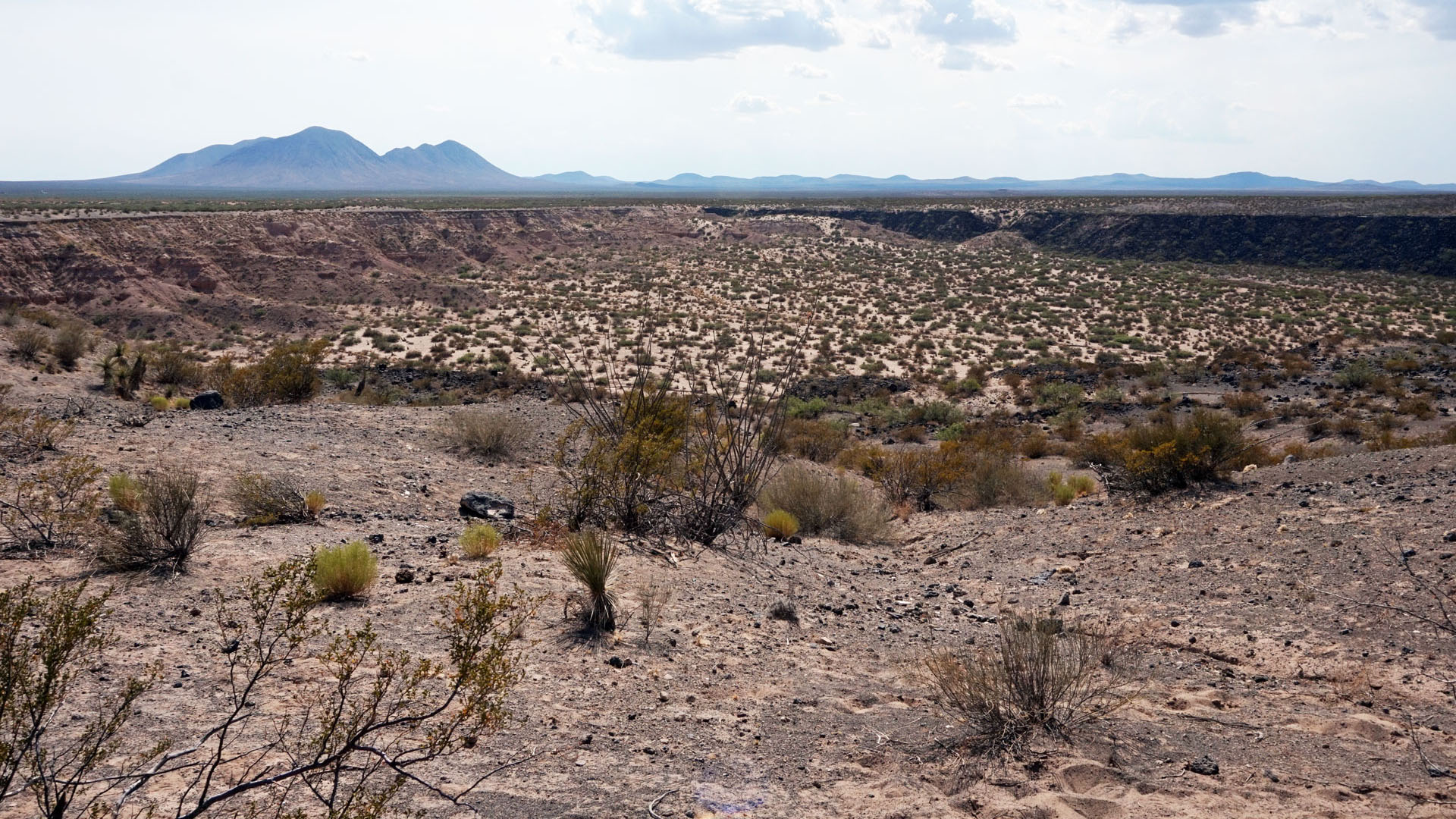
Kilbourne Hole is a maar volcanic crater two miles wide, carved out of the desert ten thousand years ago when groundwater met magma and the resulting steam blew the landscape apart. In the summer of 2017, the RIS4E team — joined by NASA astronaut Butch Wilmore — turned the crater into a stand-in for a lunar walking surface. Stony Brook student journalists embedded with them for six days, documenting the simulated spacewalks, the improvised rovers, and the rock samples held up to cameras that played mission control in Houston.
An Apollo Astronaut’s Moondust Memories
Harrison ‘Jack’ Schmitt, the last person to step onto the Moon and the only scientist ever to visit another world, returned to Kilbourne Hole in 2017, the volcanic crater where he trained for Apollo 17 nearly half a century earlier. Speaking with the RIS4E team, Schmitt reflected on the moondust hazard his crew faced and offered a blunt assessment of how to solve it.
For Some Earth Scientists, Flying to the Moon is the Ultimate Dream
Several members of the RIS4E team had applied to NASA’s astronaut corps, some more than once, and each reached the first round of interviews, a threshold fewer than one percent of applicants clear. As a new class of 12 astronauts was announced during the 2017 Kilbourne Hole expedition, the scientists reflected on a grueling process where talent alone was never quite enough.
For This Astronaut, Taking a Hike Was a Blast
NASA astronaut Barry ‘Butch’ Wilmore volunteered for six days in the New Mexico desert with the RIS4E team, trading his Johnson Space Center office for Kilbourne Hole’s scorching volcanic terrain. A veteran of two space missions, Wilmore directed simulated moonwalks and helped test geology instruments, laying groundwork for a planetary surface mission he knew he would never take himself.
Chasing Moon Dust
Since Apollo astronauts returned from the Moon sneezing and congested, scientists have known lunar dust poses a health risk, but not how serious. A team of biomedical researchers at Stony Brook University joined the RIS4E project to find out, slicing mouse lungs, probing inflammation, and measuring how lunar simulant reacts with water to produce compounds linked to lung cancer.
Data Days: Geologists Find Benefits in Pausing For Reflection
Most geological field expeditions leave data analysis for a later season, sometimes discovering equipment failures only after returning home. The RIS4E team took a different approach at Kilbourne Hole in 2017, building two dedicated analysis days into the schedule, alternating with field days, so that astronaut Butch Wilmore and geologist Liz Rampe could adjust their simulated EVAs in real time.
‘Contact’ in Real Life: Dishes in the Desert
The Very Large Array in New Mexico’s Plains of San Agustin, made famous by the 1997 film ‘Contact,’ pointed its 27 antenna dishes toward deep space long before Hollywood arrived. The RIS4E team’s 2017 New Mexico expedition offered a close look at a telescope that doubled as a time machine, capturing radio signals from galaxies more than 12 billion light years away.
Drones Over Potrillo: Seeing Planet Science from a New Angle
Two RIS4E scientists, Stephen Scheidt of the University of Arizona and Jose Hurtado of UT El Paso, flew drones over Kilbourne Hole and Aden Crater in June 2017 to build centimeter-scale three-dimensional maps of the terrain. The aerial surveys identified safe footing for simulated moonwalks and provided the missing layer of data between satellite imagery and ground-level measurements.
Inside Aden Crater, a World of Tunnels, Tubes and Pits
Ten miles from Kilbourne Hole, the RIS4E team traded ash and sand for the jagged, porous rock of Aden Crater, a small shield volcano riddled with lava tubes, pits, and collapsed tunnels. Researchers deployed LiDAR scanners and a fixed-wing drone to map the underground features, pursuing a question with stakes beyond geology: whether hollow lava tubes on the Moon could one day shelter astronauts from space radiation.
Tools in the Field
At Kilbourne Hole and Aden Crater, the RIS4E team brought an arsenal of geology instruments into the New Mexico desert, from handheld X-ray guns and LiDAR laser scanners to fixed-wing drones and days set aside for data review. The expedition tested how those tools performed in simulated astronaut scenarios, and what they revealed about the volcanic field’s past.
(16,000 Years) After the Volcano: Data Mining at Kilbourne Hole
In June 2017, NASA’s RIS4E team spent three days at Kilbourne Hole, a 300-foot-deep maar crater in southern New Mexico, testing five geology instruments in simulated spacewalks alongside astronaut Butch Wilmore. The team probed the crater’s thin ash layers and ancient lava to see whether portable, in-situ devices could extract the information scientists would otherwise need to carry home in a sample bag.
Meeting the Volcano
Volcanoes don’t always look like volcanoes. Reporting alongside the RIS4E team at the Potrillo volcanic field in June 2017, a journalist walked the rim of Kilbourne Hole, a maar blasted open 24,000 years ago when groundwater met rising magma, and learned why two craters that sit just ten miles apart were born in entirely different ways.
Finding Energy in the Moon
Solar radiation bombards the Moon’s surface so relentlessly that helium-3, a potential fusion fuel, becomes trapped inside lunar soil grains. Kate Burgess, a scientist at the Naval Research Laboratory and a member of RIS4E’s Theme 4 team, used a transmission electron microscope to image Apollo 17 samples and, for the first time, directly located the helium inside individual mineral grains, pointing toward methods for extracting it.
Kilbourne’s Volcanic Confetti
Kilbourne Hole’s 24,000-year-old eruption did more than carve a crater into the New Mexico desert. It flung mantle minerals to the surface. The coarse green crystals scattered across the volcanic field are olivine, ripped from deep inside the earth and coated in basalt as they exited. Some are gem-quality peridot, though few visitors know it, and fewer still find them.
Searching for Mars microbes by the PIXL
When NASA selected instruments for the Mars 2020 rover in 2014, a basketball-sized device from Stony Brook University made the cut. The PIXL, Planetary Instrument for X-Ray Lithochemistry, mapped the elemental chemistry of rocks point by point at a scale the size of a grain of salt, a precision no previous rover instrument could match. Its goal was finding signatures that microbial life might have left behind.
The Professor of Potrillo
Jose Hurtado, a geology professor at the University of Texas at El Paso, brought his students to Kilbourne Hole every year before the RIS4E team ever arrived. His encyclopedic knowledge of the Potrillo volcanic field made him a natural collaborator on the 2017 field test, where he and his students served as informal hosts, handing out water bottles and geological context in equal measure.
Reading a Meteorite with Laser Light
A Raman spectrometer fires a laser at a sample and reads the energy shift of the scattered light, a molecular signature precise enough to identify individual compounds. At Stony Brook University, RIS4E graduate student Jordan Young used the instrument to hunt for polycyclic aromatic hydrocarbons locked inside meteorite slices, trying to distinguish how different space rocks had chemically changed over time.
Mars in New Mexico: A Geologist in Paradise
Elizabeth Rampe, a planetary geologist at NASA’s Johnson Space Center, spent the 2017 Potrillo field test paired with astronaut Butch Wilmore, running mock EVAs along the rim of Kilbourne Hole. As deputy principal investigator of the CheMin X-ray diffractometer aboard Curiosity, Rampe had spent years studying Mars mineralogy from Houston. The analog mission let her do the same work on foot.
RIS4E in the Lab
The RIS4E team’s work extended well beyond the desert crater. Back in the laboratory, scientists at Stony Brook University probed moondust hazards, built a vacuum chamber to simulate space weathering, traced organic molecules in meteorites with laser light, and prepared an X-ray instrument destined for the surface of Mars.
Meet the RIS4E Team—And Their Hats
In the blazing New Mexico desert, safety vests made RIS4E scientists nearly indistinguishable, except for their hats. The headgear worn during the team’s 10-day field test at Kilbourne Hole in June 2017 turned out to be more than sun protection: each hat carried a story about the person beneath it, from Jake Bleacher’s legendary black leather cowboy hat to astronaut Butch Wilmore’s Australian Outback-style replacement.
The Roving Adventures of Team LiDAR
LiDAR, Light Detection and Ranging, builds precise 3D maps by bouncing laser pulses across a landscape and assembling the returns into millions of data points. At Kilbourne Hole in 2017, NASA planetary geologist Patrick Whelley hauled a 50-pound scanner across the desert to capture features from lava bubbles to full lava tubes, data he believed could one day guide rovers on the Moon and Mars.
Out in the Desert, Watching the Universe is a 24/7 Job
Keeping the Very Large Array’s 27 radio antennas trained on the sky is a round-the-clock job, and the operators who do it arrive by unlikely routes. Blythe Guvenen, who dropped out of a physics and astronomy program at the University of Arizona, found his way to the VLA through public outreach at Kitt Peak and landed the job on the strength of his problem-solving instincts alone.
Searching for Hints of Extra-Terrestrial Life in the Hard Rock of Earth
X-ray fluorescence (XRF) and laser-induced breakdown spectroscopy (LIBS) are complementary handheld tools that read a rock’s elemental chemistry in under a minute. At Kilbourne Hole in 2017, NASA scientists Kelsey Young and Amy McAdam deployed them in simulated spacewalks alongside astronaut Butch Wilmore, hunting for chemical signatures, like carbon concentrations and clay-mineral layers, that could point toward environments where life once existed.
Day 1: Water Wasn’t Enough
The opening day of fieldwork at Kilbourne Hole in June 2017 pushed the RIS4E team to its limits. Temperatures reached 105 degrees, instruments cut out mid-measurement, boot soles melted, and one journalist covering the expedition was carried off the crater floor with heat exhaustion after six hours in the desert sun.
Day 3: Keeping Everything Cool
When 105-degree heat crippled instruments and melted boot soles on the RIS4E team’s first day at Kilbourne Hole, the researchers improvised. Space blankets, ice-filled coolers, a Walmart gazebo, and doubled water rations became the unglamorous tools of planetary science, keeping people and instruments functional enough to return to the desert.
Day 5: The Astronauts’ Way
On the final field day, Apollo 17 moonwalker Harrison Schmitt returned to Kilbourne Hole, where he had trained 45 years earlier, to assess the instruments that future lunar crews might carry. He and active astronaut Butch Wilmore both pressed the RIS4E team on the same concern: efficiency, and the cost of wasted seconds on another world.
Day 5: Three Generations of Thomas, and Harrison Schmitt
When Apollo 17 astronaut Harrison Schmitt visited the RIS4E team at Kilbourne Hole in June 2017, reporter Katherine Wright seized a moment to ask him how closely the crater resembles the Moon. His answer, ‘nothing like it, but great training,’ sparked a family discovery: her father and grandfather had met Schmitt in London in 1974, when he lectured on lunar geology.
Scorching Sun and Deadly Snakes: Staying Safe in the Field
The RIS4E team’s June 2017 fieldwork at Kilbourne Hole and Aden Crater came with a full catalog of hazards: rattlesnakes, cactus needles, unstable lava footing, and temperatures that hit 105 degrees on the first day, far beyond the desert’s usual mid-90s. Team leader Jacob Bleacher had prepared exhaustively, but the heat still melted boots and sidelined instruments before the team adapted.
Seeking Shelter in Lava Tubes
Volcanic eruptions on rocky planets leave behind networks of hollow lava tubes that, on the Moon, can stretch miles wide. The RIS4E team traveled to New Mexico’s Potrillo volcanic field in June 2017 to study those formations and to test whether instruments like LiDAR could distinguish a true lava tunnel from an inflation pit, a first step toward finding shelters that might protect future astronauts from deep-space radiation.
Science Adores a Vacuum
Solar wind and micrometeoroids constantly batter airless bodies like the Moon and asteroids, darkening their surfaces in ways that confuse remote sensing instruments. To settle the debate over which force drives that change, RIS4E scientists at Stony Brook University designed an eight-inch steel vacuum cube, tested against one of the brightest X-ray beams on Earth at Brookhaven National Laboratory, to simulate space weathering in controlled conditions.
Surprises in the Desert
A caravan of journalists descended on Kilbourne Hole, New Mexico, in June 2017 to cover a NASA-funded field test unlike any other. The RIS4E team, more than 30 scientists from 10 institutions, spent 10 days in a volcanic crater that doubles as a moonscape, running simulated spacewalks with NASA astronaut Butch Wilmore and testing handheld instruments that could one day guide explorers on the Moon or Mars.
Tim Glotch: RIS4E Rock Star
Tim Glotch, a planetary geologist at Stony Brook University, led the RIS4E project, a $5.5 million NASA-funded effort, as its principal investigator. At Kilbourne Hole in June 2017 he directed a 43-person team testing handheld instruments in the desert, drawing on a career built on spectroscopy and volcanic fieldwork to prepare the science for the next human missions to the Moon and Mars.
Day 1: Paramedical Adventures
The first day at Kilbourne Hole tested the RIS4E team, and the journalists covering it, in ways no one had quite anticipated. Temperatures hit 105 degrees, two scientific instruments failed from the heat, and the drive back to El Paso turned into an 8.5-mile wrong-way detour toward the Mexican border.