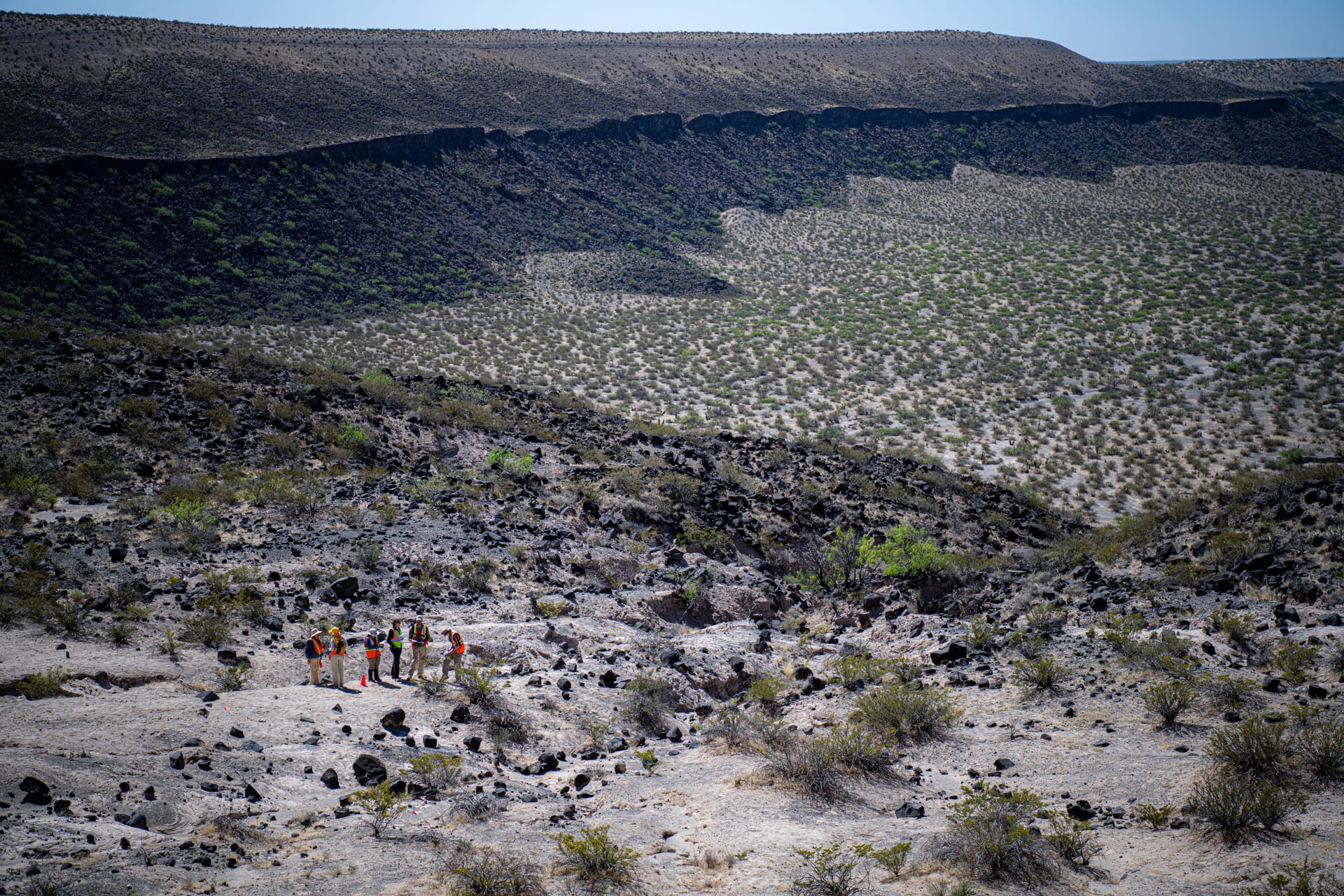
Kilbourne Hole
Building toward Artemis
By 2022, the question had shifted: not just whether the instruments worked, but whether the data they produced could fit inside the operational rhythm of an Artemis-era extravehicular activity. The April 2022 field campaign returned to the Potrillo volcanic field with a new generation of graduate students, a fuller stack of remote-sensing data, and a tighter focus on the seconds and decisions of an EVA. These dispatches, by student journalists from Stony Brook University, follow the team through the rim of Kilbourne Hole and back into the lab.
“Analog sites” on Earth provide NASA with test runs for beyond our planet
Apollo crews trained at Kilbourne Hole half a century ago. Now NASA’s RISE2 team is back in the New Mexico crater — one of the places on Earth that best impersonates another world — to rehearse the next human missions to the Moon.
Geoscience, Graduate Students, and a Global Pandemic
Nandita Kumari spent the morning doing data collection and rock identification for each extravehicular (EVA) traverse. The data and observations from scientists, Kumari hopes, will give better insight into the eruptions that have occurred and the history of rocks that remain.
From Passion Project to NASA: How Putting Data In Context Changed One Engineer’s Career
Ben Feist stood against the dusty wind at the Potrillo volcanic field. “Nothing like chasing your hat across the desert,” he quipped. The software engineer stood in the midst of a 400-square-mile otherworldly environment of parched land, craters and lava flows.
Deanne Rogers: Hyperspectral Imager
The work that the Stony Brook University geologist took on in April 2022 – perched in a volcanic field in New Mexico with a machine that analyzes the composition of rocks – may help astronauts get back to the moon and, eventually, to the red planet. “It's all about, for me, just doing good work,” she said during a break in the RISE2 expedition to the Potrillo Volcanic Field. “Keep your head down, do good work.” That she did.
For the love of simplicity and helping everyone
One of Dr. Scheidt’s key objectives on the RISE2 mission was providing UAV data with drone technology. Simulating a satellite image taken of a planetary surface, his images provide the other scientists with the necessary information to help traverse the desert terrain in a realistic manner to that of astronauts on another planet.
Strolls Through a Volcanic Crater Help Astronauts Prepare for Walks on Moon
At the Potrillo Volcanic Field, scientists and students played astronaut for an hour at a time: pretend spacewalks with mock instruments, designed to reveal which maps, data and tools real Artemis crews will actually need on the Moon.
A Giant Leap: A Personal Journey in the Steps of an Astronaut
Armed with printed maps, a line of seismometers and a sledgehammer, a student journalist joins a NASA software engineer on a simulated spacewalk — and learns how much work it takes to find a layer of basalt seven meters down.
Alice Baldridge lives to explore the Earth and tell its stories
On a hot sunny day in the deserts of New Mexico, Alice Baldridge stood on the edge of a rock one morning under the late April sky and took scientists through simulation after simulation in a volcanic crater to learn the history of the site. The geologist and educator lives to tell stories — but not as a writer, as a geologist.
In his element: Exploring seismic features with Jacob Richardson
When Jacob Richardson enters a field site, he never knows what he’ll find. As deputy principal investigator of the GEODES (Geophysical Exploration of the Dynamics and Evolution of the Solar System) team at NASA's Goddard Space Flight Center, Richardson has traveled the world conducting geological research.
How Study of Volcanoes Unearths Mysteries of Planets
The earth has untold tales throughout its history – and so do other planets. Scientists like Ernie Bell of NASA’s Goddard Space Flight Center hope to uncover the stories embedded in the earth to help people gain a better understanding of other planets. That’s the premise that brought teams of scientists to check out seismic activity at Potrillo Volcanic Field in southern New Mexico.
Kilbourne Hole: Through My Eyes
Eight-hour days in the desert leave their mark on a pair of boots — and on the person wearing them. A student journalist on what the field teaches: geology, gratitude, saying yes, and the correct emoji for awkwardness.
Zach Morse, EVA Extraordinaire
Being the field lead for the EVA (extravehicular activity) traverses at Kilbourne and Hunt’s Hole, Zach Morse knows exactly what he wants to accomplish: “How do technologies and instruments like the LIDAR (Light Detection and Ranging) interact with astronauts doing live science missions?”
The Guru of Potrillo: José Hurtado Trains Astronauts and Students in an Open-Air Classroom a Mile Wide
Professor José Hurtado knows all about working in the field. He’s completed research not just around the country, but around the world, as a seasoned geologist, from the Himalayas to New Mexico.
NASA scientists rely on sensitive tools - from handheld gadgets to bulky machines - to cull data from Earth, Moon and other worlds
Along with the human crew, the rocket blasting back to the Moon as part of the Artemis Project in 2025 will be carrying an array of highly sensitive gadgets to help the astronauts do dangerous and important jobs in space. Some of the machines used on Earth to analyze the features of analog sites like Kilbourne Hole in New Mexico will likely take the journey – or at least some instruments derived from those trusty monitors will.
Views from Hunt and Kilbourne: A Photo Essay
To most eyes the craters read as wasteland; to a geologist they’re paradise. Three days among the volcanic holes of southern New Mexico, where the groundwork for the next era of exploration is being laid — in pictures.